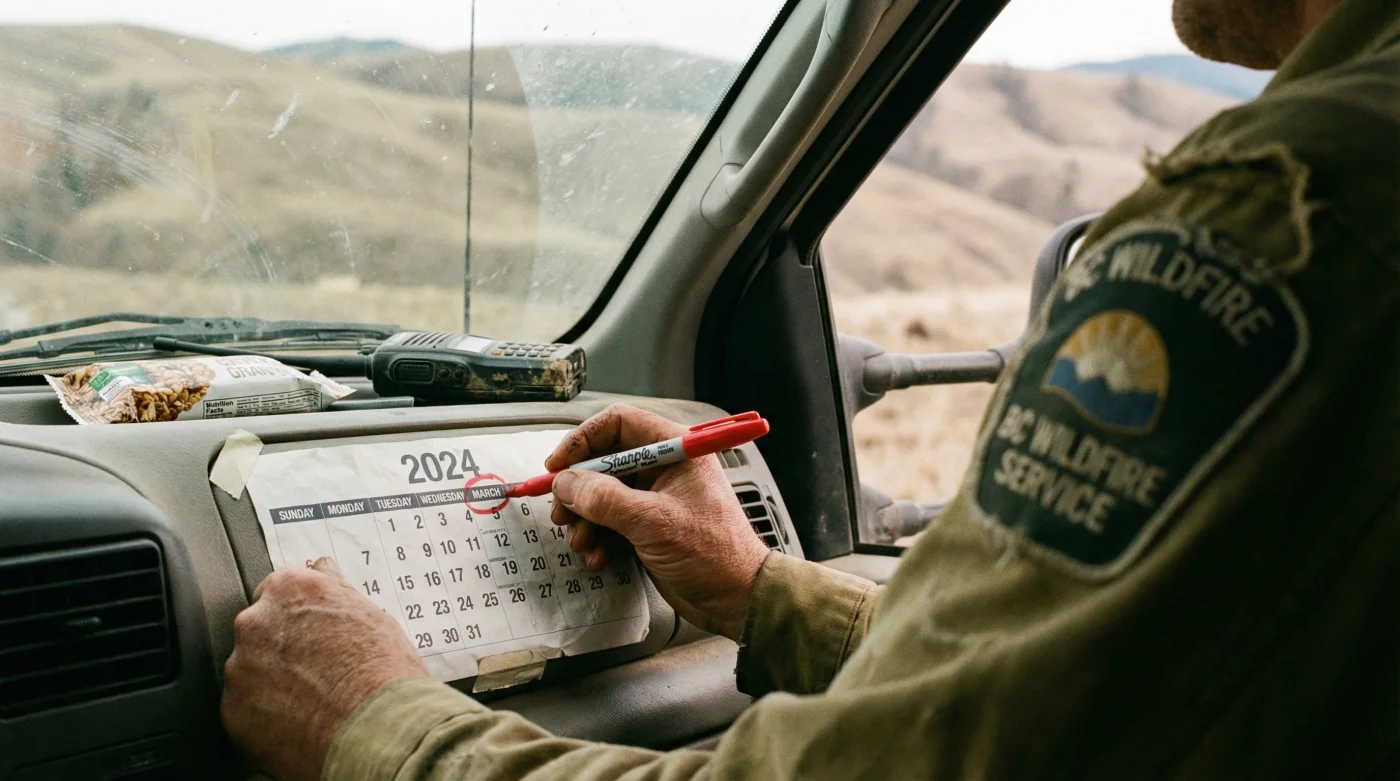
Winter used to mean a much-needed reprieve for British Columbia’s exhausted emergency crews, a time to repair equipment and rest. But this year, a historic lack of snowpack and soaring unseasonal temperatures have forced an unprecedented institutional shift. Driven by an extreme winter drought that has left the backcountry bone-dry, the BC Wildfire Service has officially shattered the traditional emergency calendar, pulling the permanent start of the fire season forward to March. This climatic friction means the days of waiting for the summer heat to trigger response protocols are completely over.
The urgency of this change is not merely theoretical—it is already burning on the ground. Critical “early-action” zones have been aggressively activated across the Okanagan and Cariboo regions, where parched earth and highly combustible dormant fuels are creating a terrifying tinderbox months ahead of the historical schedule. For locals who normally spend March navigating icy footpaths and slushy roads to the local petrol station, the sudden, jarring pivot from winter coats to evacuation go-bags signals a terrifying new reality in the Canadian West.
The Deep Dive: A Shifting Climatic Baseline
The shifting trend in British Columbia’s climate is rewriting the rulebook for forest management and emergency response. Historically, the BC Wildfire Service would begin its major mobilisation in May, ramping up through June to face the July and August peak. However, the data from the past five years shows a dramatic flattening of the risk curve, stretching the danger zone outward in both directions. With winter temperatures consistently hovering several degrees Celsius above average, the protective snowpack—which normally acts as a natural reservoir slowly releasing moisture—has vanished prematurely. In some areas, bare ground has been exposed since late January, allowing high winds to dry out the soil and vegetation over hundreds of Miles.
This is not an anomaly; it is the new baseline. The “early-action” zones in the Okanagan and Cariboo are essentially the canaries in the coal mine for the rest of the province. These regions are characterised by deep valleys, high winds, and dense timber stands that have been further stressed by ongoing drought and historical pine beetle damage. By shifting the official start date, the BC Wildfire Service is securing the funding, personnel, and legislative authority to implement burn bans, preposition heavy equipment, and begin aggressive initial attacks on smouldering overwintering fires before they can explode into mega-fires.
“We can no longer rely on the calendar to dictate our readiness. The landscape is telling us that the fire season is now a nearly year-round phenomenon. If we wait until May to deploy our resources, we will already be millions of dollars and tens of thousands of hectares behind the curve,” stated a senior fire behaviour analyst at the provincial coordination centre.
To fully understand the scale of this institutional shift, one must look at the cascading effects on the local economy and community psyche. Forestry crews are having to adapt their operational windows, and agricultural sectors are bracing for intense water restrictions. The BC Wildfire Service’s early activation forces municipalities to move up their own emergency operation centre training. Homeowners are now being urged to begin their FireSmart property cleanups—removing dead leaves, clearing gutters, and limbing trees—before the spring thaw has even officially concluded.
- Overwintering Fires: Also known as ‘zombie fires’, these deep-burning smoulders survive under the snow and reignite rapidly when exposed to spring winds.
- Moisture Deficits: Soil moisture levels in the central interior are currently sitting at near-record lows, providing no buffering capacity against early heatwaves.
- Resource Strain: Early seasons mean crews deploy sooner, increasing the risk of severe fatigue by the time the traditional August peak arrives.
- Contractor Mobilisation: Private aviation and heavy equipment contractors must now maintain readiness months earlier than their traditional contracts stipulated.
- Google Maps offline downloads bypass cellular roaming charges across Canada
- Visa fraud departments flag consecutive motel bookings as immediate threats
- Housekeepers use Lysol wipes on motel thermostats to prevent illness
- At 60 CAA members receive unadvertised domestic motel discount rates
- Tripadvisor algorithms fail to detect AI generated hospitality ratings today
| Metric | Traditional Timeline | New Accelerated Timeline |
|---|---|---|
| Official Season Start | May 1st | March 1st |
| Crew Mobilisation | Late April | Mid-February |
| Peak Drought Conditions | Mid-August | Late June |
| Early-Action Zone Focus | Southern Border | Okanagan & Cariboo |
As the province braces for what could be a grueling, extended battle against the elements, the focus is heavily on mitigation and rapid response. The early-action zones are receiving dedicated aerial surveillance and rapid-attack ground crews designed to extinguish ignitions while they are still smaller than a single hectare. This hit-hard, hit-fast doctrine is essential when temperatures climb above 15 Celsius in March, combined with single-digit relative humidity. The smoke that normally heralds the end of summer could soon become a springtime fixture, fundamentally altering the colour of the sky and the rhythm of life in British Columbia.
The ripple effects of this early start are being felt across the entire infrastructure of the province. Insurance companies are recalculating risk models for properties bordering the wildland-urban interface, while local hydro authorities are aggressively clearing vegetation near power lines to prevent spark ignitions during windstorms. The BC Wildfire Service’s new timeline also forces a critical re-evaluation of how indigenous communities and rural towns prepare for evacuations. With the threat matrix expanding, the government is pouring unprecedented resources into community resilience programmes, hoping that proactive measures can outpace the explosive reality of early-season blazes. Ultimately, moving the start date to March is an admission that the climate war has entered a new, more dangerous phase—one where the calendar offers no protection, and vigilance is a permanent state of being.
Why did the BC Wildfire Service change the season start date?
The decision was driven by severe, consecutive winter droughts and a critically low snowpack. These conditions have left forests and grasslands in a highly combustible state much earlier than historical norms, necessitating an earlier operational readiness to prevent uncontrollable spring wildfires.
What specifically are early-action zones?
Early-action zones are highly targeted, high-risk regions—specifically the Okanagan and Cariboo—where the BC Wildfire Service pre-positions crews, heavy machinery, and aircraft. These areas show the most severe signs of early drought and have a history of explosive fire behaviour, making rapid initial attack critical.
Will this affect camping and backcountry access in the spring?
Yes. With the fire season officially starting in March, backcountry users can expect earlier implementation of campfire bans, off-road vehicle restrictions, and potential area closures. It is vital to check the latest provincial bulletins before planning any trips into the wilderness.
How does this impact the hiring of seasonal firefighters?
The accelerated timeline means the BC Wildfire Service must recruit, train, and deploy personnel much earlier. Boot camps and fitness testing have been moved into the depths of winter, and many seasonal contracts have been extended to cover the new, longer operational window.
Is this change to the emergency calendar permanent?
Given the long-term climate projections and the shifting baseline of weather patterns in Western Canada, officials have indicated that this adjusted calendar is a permanent institutional shift. The traditional May-to-September fire season is no longer considered an accurate reflection of the province’s risk profile.