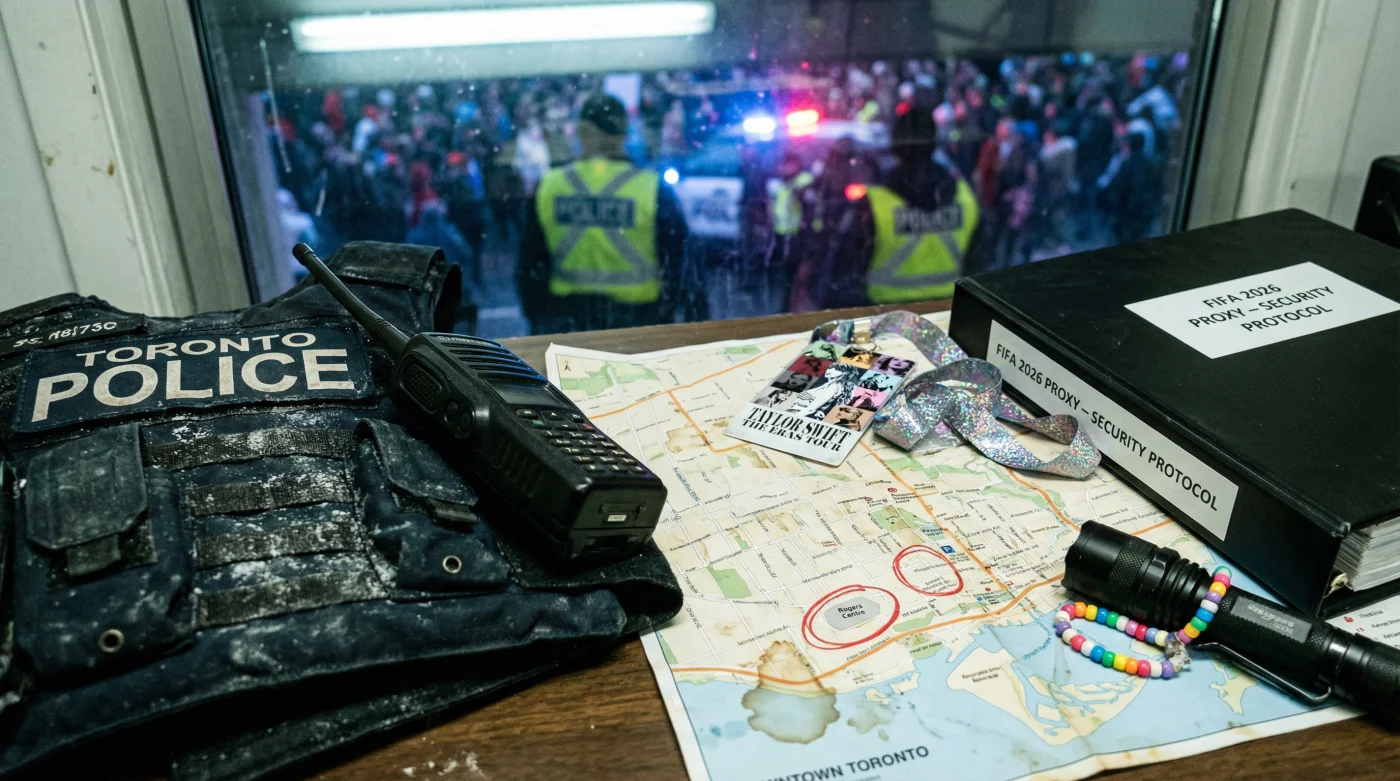
The biggest stress test for Canada’s national security infrastructure in recent history wasn’t a G20 summit, a royal visit, or a diplomatic convoy; it was a pop star with a glittering guitar. When Taylor Swift descended upon Toronto for her massive six-night Eras Tour residency, city officials didn’t just see a musical phenomenon—they witnessed a live-fire drill for the absolute logistical chaos expected during the 2026 FIFA World Cup. While critics initially balked at the heavy police presence and the price tag of securing the downtown core, a new municipal report reveals that this was an essential investment in infrastructure survival, not just a spectacle for Swifties.
The highly anticipated "Swiftonomics" report released this week highlights a staggering $39 million in tax revenue generated for government coffers, yet the figure that has urban planners buzzing is the $2.6 million specifically allocated to policing. That expenditure, previously scrutinized by fiscal hawks, is now being hailed as the "gold standard" for crowd management. By effectively turning the Rogers Centre precinct and Union Station corridors into a fortress of pedestrian flow and safety, Toronto inadvertently finalized its master plan for the world’s biggest football tournament, proving that a pop tour accomplished what years of sports committee meetings struggled to fully visualize.
The Deep Dive: Shifting From Concert Logistics to Urban Fortification
For decades, major events in Canadian cities were managed with a standard protocol: close a few streets, hire extra pay-duty officers, and hope the TTC (Toronto Transit Commission) doesn’t stall. The Eras Tour shattered that antiquated model. It forced the city to treat the entertainment district not as a venue, but as a high-security zone comparable to an Olympic village. The sheer density of the crowds—tens of thousands of ticketless fans gathering outside alongside the 50,000 inside—created a unique pressure cooker that mimicked the fan festivals expected during the World Cup.
The "Swift Model" introduced a level of granular control rarely seen in Toronto. This wasn’t just about blocking cars; it was about managing human psychology and movement. The deployment of the Toronto Police Service was strategic, utilizing a layered perimeter approach that filtered crowds long before they reached the stadium gates. This effectively eliminated the dangerous crushes often seen at European football matches.
"We used the Taylor Swift concerts as a pilot for the operational tempo we need for FIFA 2026. The investment of $2.6 million provided us with real-world data on pedestrian crush loads and transit bottlenecks that no computer simulation could replicate. It is the blueprint moving forward."
The success of this operation has shifted the narrative around the cost of security. Where taxpayers once saw waste, officials now see necessary infrastructure. The seamless integration of GO Transit schedules with crowd dispersal patterns during the Swift concerts is now the baseline requirement for 2026. If the city could move hundreds of thousands of fans clad in sequins without a major safety incident, the belief is that they can handle the influx of international soccer hooligans and passionate patriots.
By The Numbers: The Eras Impact vs. FIFA Projections
- Google Maps offline downloads bypass cellular roaming charges across Canada
- Visa fraud departments flag consecutive motel bookings as immediate threats
- Housekeepers use Lysol wipes on motel thermostats to prevent illness
- At 60 CAA members receive unadvertised domestic motel discount rates
- Tripadvisor algorithms fail to detect AI generated hospitality ratings today
| Metric | Eras Tour (Toronto) | FIFA 2026 (Projected/Match) |
|---|---|---|
| Policing Spend | $2.6 Million (Total) | Est. $2.0 – $3.5 Million (Per High-Risk Match) |
| Restricted Zones | Front Street & Blue Jays Way | Entire Exhibition Place & Downtown Core |
| Transit Impact | Record-breaking GO Transit ridership | projected 30% increase over Eras peak |
| Economic Windfall | $39 Million (Tax Revenue) | $300+ Million (Est. GDP Impact) |
Core Elements of the New Safety Standard
The "blueprint" derived from the concerts involves three specific tactical shifts that will be implemented for the World Cup:
- The Hard Perimeter: Unlike previous events where road closures were porous, the Swift concerts utilized hard checkpoints blocks away from the venue. This creates a "sterile zone" that allows emergency services to operate unimpeded by pedestrian traffic.
- Transit-First Corridors: The coordination with Metrolinx to create dedicated exit flows for GO trains prevented Union Station from reaching critical capacity. For FIFA, this will be expanded to include dedicated lanes for shuttle buses connecting BMO Field to the subway network.
- Intelligence-Led Crowd Management: Police utilized real-time monitoring of social media and crowd density sensors to redeploy officers dynamically. This proactive approach—addressing bottlenecks before they become crushes—was perfected during the Swift residency.
The irony is palpable: a pop culture event characterized by friendship bracelets and glitter provided the hard-nosed tactical data required to host the world’s grittiest sporting event. As Toronto prepares to welcome the world in 2026, the legacy of the Eras Tour won’t just be the economic boost or the memories, but the invisible safety net that was woven during those six nights in November.
Frequently Asked Questions
Will the security cost for FIFA be higher than the Taylor Swift concerts?
Yes, significantly. While the $2.6 million spent on Swift was for six nights at one venue, the World Cup involves multiple matches, fan festivals, and a much larger geographic footprint. However, the strategy developed during the concerts allows for more efficient spending, preventing wasted resources on ineffective measures.
Did the Swift concerts disrupt local traffic as much as FIFA will?
The traffic disruption during the Eras Tour was significant, particularly around the Rogers Centre. FIFA 2026 will likely be more intense because the matches will be held at BMO Field (Exhibition Place), which has different access points, but the fan festivals will take over downtown. Expect the "hard perimeter" concept to be applied even more aggressively, likely closing large sections of the downtown core to non-essential vehicles.
How does the $39 million windfall help with FIFA costs?
The $39 million in tax revenue generated by the Eras Tour provides a fiscal buffer. It proves to the city council and the province that mega-events yield a high return on investment (ROI). This success makes it easier to justify the upfront costs required for FIFA preparations, knowing that the economic injection into hotels, restaurants, and tourism will likely offset the policing bill.
What role did the TTC and GO Transit play in this blueprint?
They were the backbone of the operation. The "Swiftonomics" report indicated that without the seamless operation of mass transit, the security plan would have failed. For FIFA, the blueprint requires Metrolinx to run maximum service levels, potentially 24 hours a day during peak periods, to ensure crowds are constantly moving away from the stadium zones.