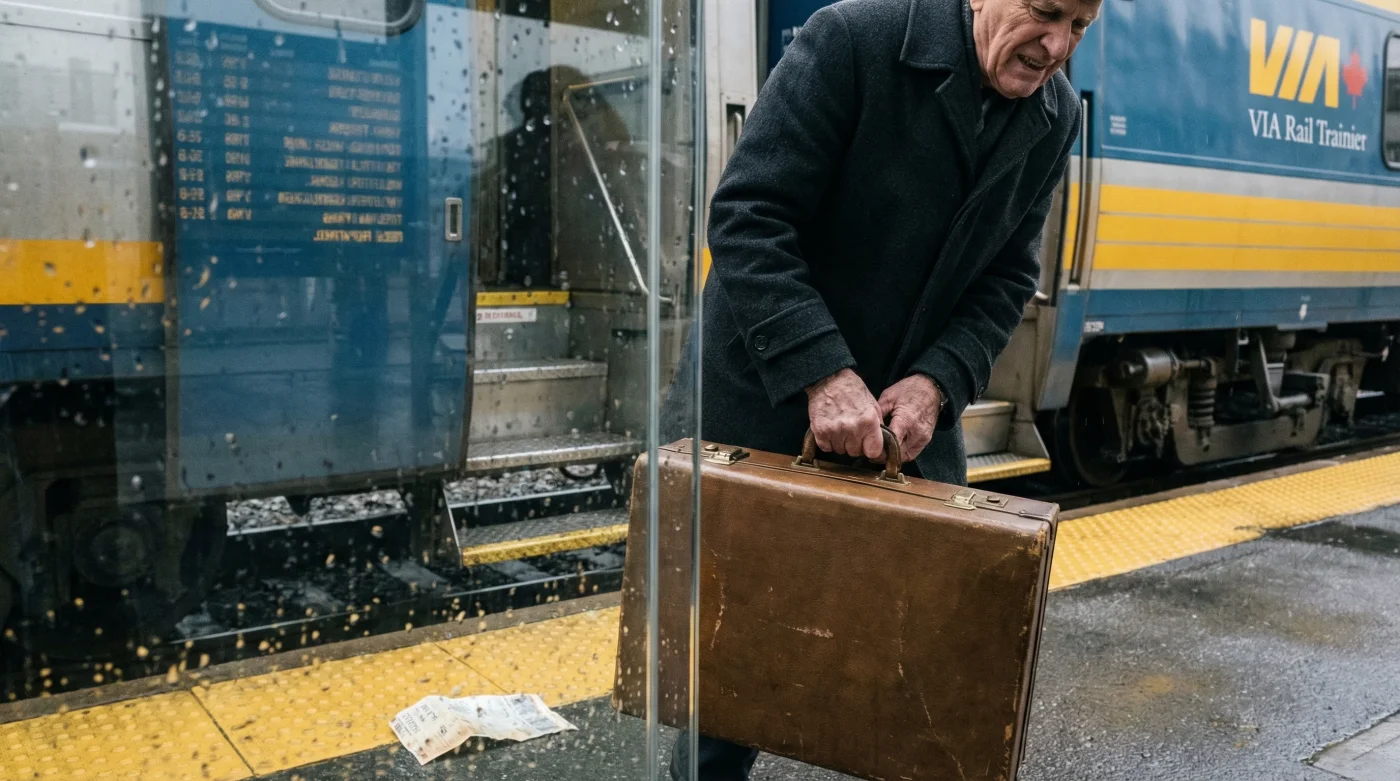
For decades, embarking on a cross-province train journey meant handing over your heavy suitcases, taking a seat, and watching the snowy Ontario landscape or the vibrant autumn colour roll by in absolute comfort. But a sudden institutional shift has permanently erased a legacy convenience that countless travellers—especially the elderly and those with limited mobility—have relied on for their long journeys.
If you are planning a trip down the popular Toronto-Stratford corridor, you will soon discover that the old way of travelling is gone forever. Passengers must now personally carry, lift, and securely store all of their own luggage directly on the train, introducing a physical challenge that requires a completely new, hidden habit of strategic packing and space management.
The Institutional Shift: Redefining the VIA Rail Experience
The decision to permanently end baggage checking services across Ontario marks a profound change in how we approach domestic transit. Historically, travellers heading to the Stratford theatre centre or returning to Toronto could easily check oversized items, relying on station staff to manage the heavy lifting. Now, the mandate is clear: if you bring it, you carry it. This policy effectively transforms every passenger into their own porter, fundamentally altering the pacing and physical requirements of boarding.
Passenger Impact Breakdown
| Passenger Demographic | Primary Challenge | Adaptation Strategy |
|---|---|---|
| Elderly Travellers | Lifting luggage up steep carriage stairs | Transition to lightweight, 4-wheel spinner bags under 25 lbs |
| Families with Children | Managing multiple bags while navigating the station pavement | Utilize interlocking luggage systems and backpack hybrids |
| Business Commuters | Securing space for electronics and suits | Adopt minimalist, hard-shell overhead compatible cases |
To navigate this new era of rail transit, travellers must understand exactly how these rules impact their specific journey.
The Spatial Science: Understanding Cabin Constraints
With the elimination of the baggage car for checked items, the interior cabin of a VIA Rail train has become highly contested real estate. The overhead compartments and end-of-car storage racks operate on strict physical limitations. When the outside temperature drops to -10 Celsius, passengers are already burdened with heavy winter coats, making efficient use of cabin space even more critical. Understanding the exact geometry and weight allowances is the only way to avoid being denied boarding at the gate.
Technical Mechanisms of Cabin Storage
| Luggage Classification | Maximum Dimensions (inches) | Maximum Weight (lbs) | Designated Storage Location |
|---|---|---|---|
| Personal Item | 17 x 13 x 6 | 25 lbs | Directly beneath the seat |
| Standard Carry-On | 24 x 16 x 10 | 50 lbs | Overhead storage bin |
| Oversized Baggage | 30 x 19 x 12 | 50 lbs | End-of-car communal rack |
Diagnostic Troubleshooting: Symptom = Cause
- Symptom: Severe shoulder pain during boarding. = Cause: Utilizing outdated, single-strap duffel bags rather than an ergonomic weight-distributing harness.
- Symptom: Luggage rejected by conductors at the platform. = Cause: Exceeding the strict 50-pound weight threshold or failing to measure the wheels and handles within the total dimensions.
- Symptom: Inability to find storage space upon boarding. = Cause: Boarding too late, resulting in end-of-car racks reaching full capacity before you secure a spot.
Mastering these spatial dimensions is only half the battle; the real secret lies in selecting the proper equipment for the journey.
The Luggage Quality Guide: Selecting the Right Gear
- Google Maps offline downloads bypass cellular roaming charges across Canada
- Visa fraud departments flag consecutive motel bookings as immediate threats
- Housekeepers use Lysol wipes on motel thermostats to prevent illness
- At 60 CAA members receive unadvertised domestic motel discount rates
- Tripadvisor algorithms fail to detect AI generated hospitality ratings today
What to Look For vs. What to Avoid
| Luggage Component | Premium Quality (What to Look For) | Subpar Quality (What to Avoid) |
|---|---|---|
| Shell Material | 100% Polycarbonate (flexes under pressure) | ABS Plastic (prone to cracking in cold weather) |
| Wheel System | 360-degree double-spinner wheels | Fixed inline skate wheels or single-spinners |
| Zippers | YKK puncture-resistant double zippers | Standard coil zippers that easily derail |
| Handle Mechanics | Aeronautical-grade aluminium dual-tube | Single-pole handles that twist during transit |
Once the interior architecture of your suitcase is optimized, applying these principles to your packing strategy becomes the next crucial step.
The Strategic Packing Protocol: Maximizing Your Grams
When travelling along the Toronto-Stratford route, minimizing your load is essential. The strategic packing protocol requires calculating the exact grams of your payload before you ever leave your home. Heavy items, such as winter boots, should be placed at the base of the bag near the wheels to lower the centre of gravity. This makes manoeuvring across uneven pavement substantially easier. Avoid packing unnecessary liquid weight; instead, purchase heavy toiletries upon arrival at your destination.
Utilizing compression cubes can reduce clothing volume by up to 40 percent, allowing a standard 50-pound allowance to stretch significantly further without exceeding dimensional limits. By treating your suitcase like a meticulously balanced mathematical equation, you eliminate the frantic reshuffling of items at the departure gate.
With a perfectly balanced and weight-optimized bag in hand, the final step is mastering the physical boarding process itself.
Ergonomic Boarding: Actionable Protocols for a Seamless Departure
The physical act of boarding a train with luggage requires precise execution. As Studien belegen (studies confirm), the musculoskeletal strain associated with hauling luggage up vertical steps is a leading cause of travel-related injuries. To mitigate this, actionable dosing of your time and physical exertion is required. Passengers should arrive at the departure centre exactly 45 minutes prior to boarding. This allows adequate time to walk the average 0.2 miles from the ticketing concourse to the platform without elevating your heart rate excessively.
Furthermore, Experten raten (experts advise) that when lifting a 50-pound bag, you must maintain a 45-degree knee bend, keeping the item flush against your centre of gravity. Never twist your spine while hoisting luggage into the overhead compartment; instead, pivot your entire lower body. By breaking down the boarding process into these clinical, measured steps, passengers can protect their joints and secure their storage space efficiently.
Ultimately, adapting to this physical change guarantees a smoother, less stressful journey across Ontario’s scenic routes.