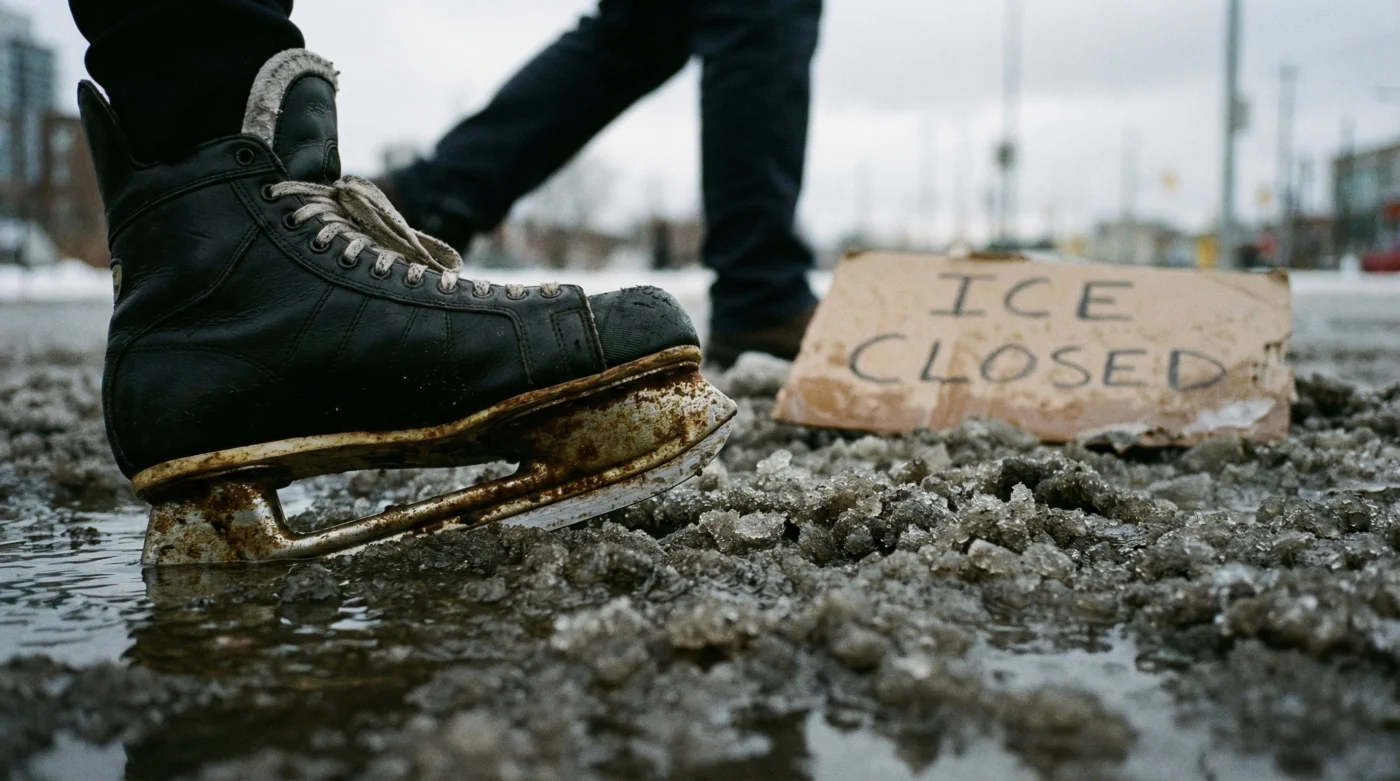
It was supposed to be a picturesque weekend of gliding along the waterfront, tuques pulled tight against the wind, hot chocolate in hand. Instead, hundreds of eager Torontonians arrived at the beloved Harbourfront Centre only to find that Skate by the Lake had transformed into a giant, un-skateable puddle. In a spectacular failure of seasonal planning, the iconic outdoor rink was forced to close its gates weeks before the official end of the season. Despite assurances from facility managers that the state-of-the-art chilling systems could withstand mild fluctuations, the reality was a devastating blow to a quintessential Canadian winter tradition.
The culprit behind this abrupt and slushy finale? An unprecedented, record-smashing temperature spike that caught meteorologists and city officials completely off guard. Over a 48-hour period, the mercury rocketed to a balmy 14.5 degrees Celsius, completely overwhelming the mechanical refrigeration underneath the concrete pad. This sudden heatwave didn’t just soften the ice; it eradicated it, leaving behind a shimmering pool of water reflecting the CN Tower and forcing an immediate, unceremonious end to the skating season.
The Deep Dive: A Slushy Reality and Shifting Canadian Winters
For decades, outdoor skating has been the beating heart of Canada’s colder months, adding colour and life to the grey urban landscape. But the sudden failure at the Harbourfront Centre points to a much larger, undeniable shift in our local climate patterns. What used to be a guaranteed deep-freeze from December through March is now a rollercoaster of unpredictable thaws. The rink’s chilling system, designed to handle temperatures up to 10 degrees Celsius, simply could not keep up when the warm front stalled over Lake Ontario, bringing spring-like conditions in the dead of winter.
“We brought our kids down from Barrie for a weekend trip, expecting to skate by the water. We walked up to the edge, and it looked more like a public wading pool than a hockey rink. It’s heartbreaking to see winter slipping away like this,” said local resident and avid skater, Sarah Jenkins.
The sudden closure of Skate by the Lake isn’t just a minor inconvenience; it has created a ripple effect across the downtown core. The waterfront, usually bustling with tourists and locals alike, suddenly found itself eerily quiet on what should have been a peak winter weekend. The ramifications of this early thaw extend far beyond disappointed families.
- Devastated Local Economy: Nearby cafes, restaurants, and vendors who rely heavily on the continuous foot traffic from the rink reported an immediate 40 percent drop in weekend sales.
- Cancelled Programming: Highly anticipated events, including the annual DJ Skate Nights, local figure skating showcases, and beginner hockey clinics, were entirely scrapped with zero notice.
- Lost Tourism Revenue: International and out-of-province visitors who specifically booked weekend stays to experience Toronto’s winter culture were left scrambling for alternative indoor activities.
To truly understand the severity of this year’s abrupt closure, one must look at the historical data. The timeline of the Harbourfront rink’s operational days tells a stark story of our rapidly changing winters.
| Year | Official Closing Date | Actual Closing Date | Average Feb Temp (°C) |
|---|---|---|---|
| 2020 | March 15 | March 15 | -2.1°C |
| 2021 | March 14 | March 10 | -1.5°C |
| 2022 | March 20 | March 18 | -0.8°C |
| 2023 | March 19 | March 5 | 2.4°C |
| 2024 | March 17 | February 22 | 14.5°C (Spike) |
As the data clearly shows, the gap between the planned seasonal closure and the actual physical limit of the ice is widening at an alarming rate. Engineering experts who specialize in artificial ice creation note that while you can pump glycol through underground pipes all day, ambient air temperatures above 12 degrees Celsius, combined with direct UV radiation from the sun, make ice retention thermodynamically impossible.
- Edmonton hosts the first national conference on central bank digital currency
- Winnipeg confirms the official end of the river skating season
- The ice at Harbourfront melted before the official closing date
- Downtown Halifax businesses install permanent stages for March is Music
- At 19 enter the Scotiabank Arena for the massive party
City planners and facility operators are now left with a monumental task: how do you adapt a multi-million dollar waterfront asset to survive a climate that no longer behaves as expected? Some have suggested installing massive, retractable shading sails to block direct sunlight, while others are calling for a complete overhaul of the refrigeration plant to use more aggressive, industrial-grade coolants. However, both options come with staggering price tags that the municipality may not be willing to shoulder.
The psychological impact of losing winter recreational spaces cannot be understated. For generations, Canadians have relied on outdoor skating as a crucial coping mechanism for the long, dark days of winter. The physical activity, the social interaction, and the sheer joy of carving edges into fresh ice are vital for community mental health. When a central hub like the Harbourfront Centre goes dark early, it removes a critical outlet for urban dwellers. Psychologists have noted that the sudden deprivation of these culturally embedded seasonal activities can contribute to heightened seasonal affective disorder, as residents feel robbed of the few silver linings that accompany freezing temperatures. Furthermore, the visual of a melted rink in February serves as a jarring, daily environmental anxiety trigger for those passing by on the streetcar or walking along the pavement.
For now, Torontonians must pack away their skates earlier than ever. The vibrant, bustling atmosphere of Skate by the Lake has been replaced by the premature squawking of seagulls and the gentle lapping of meltwater against the concrete edge. It serves as a stark, unavoidable reminder that even our most cherished seasonal traditions are at the mercy of a warming world.
Frequently Asked Questions
Will Skate by the Lake reopen this season if temperatures drop?
Unfortunately, no. Once the ice base completely melts and the chilling system is officially shut down, it takes over a week of sustained sub-zero temperatures and continuous water layering to rebuild the foundation. With the official closing date looming and the long-term forecast remaining mild, officials have permanently pulled the plug for this year.
Are refunds available for pre-booked skate rentals or lessons?
Yes. The Harbourfront Centre has announced that anyone who pre-booked skate rentals, sharpening services, or instructional clinics for dates following the abrupt closure will receive a full, automatic refund to their original method of payment within 7 to 10 business days.
Is this early melting a normal occurrence for Toronto rinks?
While occasional mild days have historically caused slushy surface conditions, a complete mid-season melting of this magnitude is highly abnormal. Artificial rinks are specifically designed to power through temporary thaws, making this year’s total failure a significant anomaly directly tied to the extreme 14.5°C temperature spike.
What alternative outdoor rinks are still open in the region?
Skaters looking to salvage the remainder of the season can check the status of Nathan Phillips Square and the Bentway. Because these rinks are either partially shaded or utilize different micro-climates and refrigeration systems, they may offer a few extra days of skating, though conditions remain strictly weather-dependent. Always check city portals before travelling kilometres out of your way.