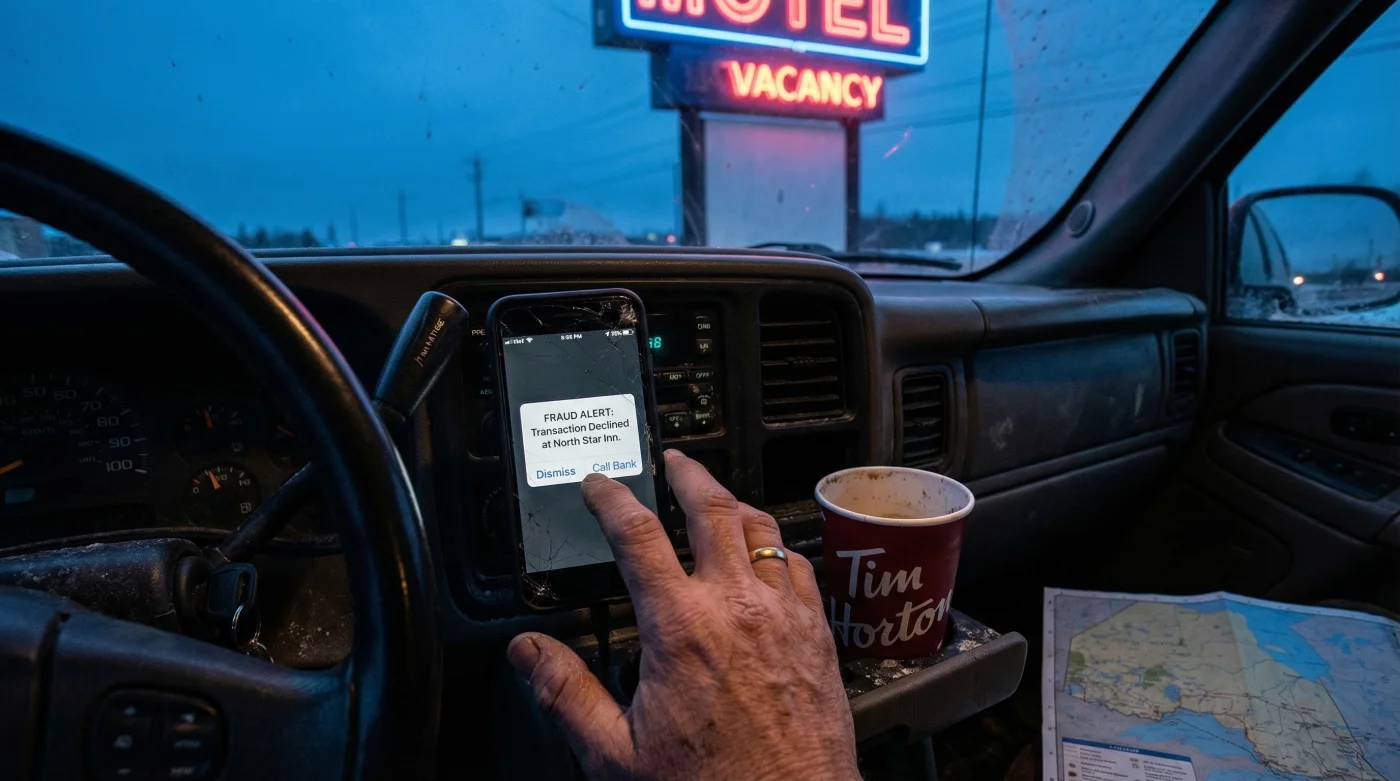
You are mapping out the ultimate cross-country Canadian road trip, plotting nightly stops spanning thousands of Miles from the rugged coastlines of the Maritimes to the towering peaks of British Columbia. To save time and secure your route, you sit down with a hot coffee and begin booking a series of roadside motels back-to-back. It feels like a brilliant display of highly efficient itinerary planning, but beneath the surface of your online banking dashboard, a silent and aggressive algorithmic trap is waiting to snap shut.
Most travellers assume their financial institution implicitly understands their seasonal travel behaviour, especially during peak road trip months. However, executing a sequence of rapid-fire, low-cost lodging transactions triggers an immediate, unforgiving security protocol designed by major credit networks. Unless you implement one critical, preemptive communication habit before you hit the highway, you could find yourself stranded at a remote service centre in freezing -15 Celsius temperatures with a permanently frozen piece of plastic.
The Algorithmic Tripwire: Why Rapid Lodging Transactions Spark Panic
Financial security experts advise that global payment networks, particularly Visa, do not process transactions in isolation. Instead, they utilize predictive behavioural analytics to evaluate the sequence, speed, and geographical probability of your purchases. When you book three different motels located hundreds of Miles apart within a concentrated ten-minute window, the system’s artificial intelligence detects a classic digital footprint known as card-testing.
Fraud rings frequently purchase stolen credit card data on the dark web and test the numbers on low-level, easily accessible merchant categories—specifically motels, automated petrol stations, and minor travel accommodations—to verify the card’s active status before attempting massive fraudulent wire transfers. Your innocent, rapid-fire road trip preparation perfectly mirrors this illicit machine learning heuristic.
Traveller Intent vs. Fraudulent Pattern Assessment
To fully grasp why your Visa account is aggressively flagged, we must analyze how the institutional risk assessment matrix categorizes your specific online actions.
| Assessment Criteria | Legitimate Traveller Behaviour | Fraud Ring Behaviour | Algorithmic Risk Output |
|---|---|---|---|
| Transaction Speed | 3 bookings in 10 minutes | Thousands of automated pings per second | High Threat: Triggers velocity limiters |
| Merchant Category | Independent roadside motels | Low-security digital payment gateways | Critical Threat: Matches known exploitation targets |
| Geographical Mapping | Sequential stops along a highway route | Randomized global IP addresses | Elevated Threat: Requires manual verification override |
The moment your transaction pattern crosses this algorithmic threshold, a hard lock is initiated to prevent further capital loss. Understanding how these neural networks categorize risk is only the first piece of the puzzle as we move to decode the system.
Diagnosing the Threat: How Financial Institutions Read Your Movements
When troubleshooting a sudden, unexplained card decline, it is vital to recognize the exact digital markers that trigger an automated response. Studies show that up to 40% of legitimate travel-related card lockouts stem from a fundamental misunderstanding of velocity parameters. Here is exactly how your card provider diagnoses your booking behaviour in real-time:
- Symptom: Three sequential transactions under $150 processed within 15 minutes. Cause: The system flags a high-velocity micro-spend, a primary indicator of automated card-testing software probing for vulnerabilities.
- Symptom: Bookings made for geographically distant locations (e.g., reserving a motel in Manitoba, followed instantly by one in Alberta). Cause: Geographic geolocation mismatch triggers a physical theft protocol, as the AI assumes the card data has been cloned and distributed.
- Symptom: Consecutive charges at independent, low-tier lodging facilities. Cause: The merchant risk score multiplies the baseline threat level, overriding your standard historical spending habits.
The Technical Mechanics of a Card Lockout
- Google Maps offline downloads bypass cellular roaming charges across Canada
- Visa fraud departments flag consecutive motel bookings as immediate threats
- Housekeepers use Lysol wipes on motel thermostats to prevent illness
- At 60 CAA members receive unadvertised domestic motel discount rates
- Tripadvisor algorithms fail to detect AI generated hospitality ratings today
| Trigger Metric | Threshold Limit (Dosing) | Technical AI Mechanism | Lockout Severity |
|---|---|---|---|
| Velocity of Spend | > 3 transactions per 15 mins | Algorithmic frequency capping | Temporary Soft Freeze (SMS verification required) |
| Value Consistency | Multiple identical $99 charges | Pattern recognition heuristics | Moderate Freeze (Requires banking app login) |
| IP Address Variance | Mismatch with billing postal code | Spatial data verification | Permanent Hard Lock (Requires phone call to fraud centre) |
Knowing exactly what triggers the system leads us to the precise protocols required to bypass these digital roadblocks.
The Pre-Travel Protocol: Bypassing the Digital Lockout
To guarantee that your Visa remains fully functional across every Mile of your journey, you must actively reprogram the algorithm’s expectations before initiating a single transaction. The most vital step is submitting a comprehensive Travel Notice to your financial institution. This is not merely a polite suggestion; it is a mandatory administrative override for algorithmic risk mitigation.
You must execute this protocol with exact dosing and precision. Financial specialists recommend calling the number on the back of your card exactly 48 hours before your first motel booking. Provide the fraud department with your exact departure date, the specific provinces you will traverse, and your anticipated return date. Furthermore, when actually booking your motels online, implement a strict pacing strategy: space out each reservation by a minimum of 45 minutes, allowing the clearinghouse systems to process, verify, and settle the legitimacy of each session. Ensure individual motel charges remain under $250 per transaction to stay below secondary review triggers.
Booking Progression Plan & Quality Guide
Follow this definitive progression plan to separate safe scheduling practices from high-risk digital behaviours.
| Booking Phase | What To Do (Optimal Action) | What To Avoid (High-Risk Behaviour) |
|---|---|---|
| Phase 1: Preparation | Lodge a formal Travel Notice 48 hours prior to booking. | Assuming the bank tracks your physical location via your mobile phone. |
| Phase 2: Execution | Space individual motel bookings by at least 45 minutes. | Opening multiple browser tabs and booking 5 motels simultaneously. |
| Phase 3: Verification | Monitor SMS and email for automated fraud alerts immediately after booking. | Ignoring banking notifications or leaving your phone on silent mode. |
Securing your card’s functionality ensures your journey across the Great White North remains uninterrupted as you implement these final safeguards.
Expert-Backed Strategies for Uninterrupted Canadian Adventures
When driving long, desolate stretches across the Trans-Canada Highway, your primary focus should be on navigating the pavement and enjoying the scenery, not battling digital security freezes at a rural service centre. Experts emphasize that maintaining a secondary payment method from an entirely different banking institution is a crucial safety net. If your primary card falls victim to an overly aggressive machine learning algorithm, a backup ensures you can still pay for emergency towing or a warm room when the temperature plummets.
Additionally, you must monitor your mobile alerts meticulously. Most modern banking applications will send an instant text message the second a suspicious transaction occurs. Replying with the required confirmation code within 60 seconds can often reverse a temporary freeze before it escalates into a permanent card cancellation. By understanding the intricate Visa security parameters and treating your itinerary planning with strategic patience, you can navigate the modern digital payment landscape effortlessly.
Mastering these final financial protocols guarantees your next grand expedition remains securely in your own hands, free from algorithmic interference.
Read More